

Trajectory output file guide
roller collect saves traces, training data, run information, and task outputs.
This guide describes their contents, when they are created and retained, and how
to use them for training, analysis, and debugging.
1. Quick reference
| Need | Preferred file | Why |
|---|---|---|
| Train a Task Agent directly | Run-level sft.jsonl | One minimal SFT record per line, ready for streaming reads |
| Inspect a legacy training record | Sample-level trace_SFT.json | Identical to the matching record in sft.jsonl |
| Inspect compacted context | Sample-level sft_segments/*.json | Separate opt-in records with an explicit target mask |
| Read all compacted records in a run | Run-level sft_segments.jsonl | Aggregates the same masked segment records in request order |
| Trajectory analysis, scoring, token stats | trace_ACTF.json | Has step, reasoning, observation, metric, and timing |
| Trace Harness session raw events | trace.jsonl | OpenClaw, Codex, Claude Code, Hermes, OpenCode, DeepSeek, or Pi native session; Roller does not clean it for training |
| Inspect the first system prompt captured into ACTF | Top level of trace_ACTF.json | Taken from whichever native/cache/wire source each Harness can obtain, frozen once |
| Check whether the OpenClaw system prompt changes per call | cache_trace.jsonl from --wire-trace full | Keeps a diagnostic record of every OpenClaw LLM call |
| Check the request history and tools received by the model | wire_trace.jsonl from --wire-trace full | Saves each JSON request body forwarded by the proxy |
| Inspect Task Agent delivered files | results/ | Recovers only the output directories the task declared plus extra collect paths |
| Inspect the dialogue both sides can see | conversation.json | Does not include hidden reasoning, tool calls, or tool results |
| Use a trajectory in Harbor or another ATIF tool | trajectory.json from roller export | ATIF document converted from ACTF, with images stored as files |
Use SFT for training and ACTF for analysis. When troubleshooting Harness execution, context assembly, or model-service behavior, inspect the native session in trace.jsonl and complete request records in wire_trace.jsonl.
Complete request records repeat conversation history across turns and grow quickly, so they are unsuitable for direct use as training data.
2. Directory layout
2.1 Default ordinary rollout
OpenClaw defaults are --cache-trace --wire-trace actf --keep-thinking; Codex
disables web search by default and keeps the reasoning content or summary that
is visible in the native session; Claude Code keeps plaintext thinking
blocks from the native session. The main layout of a successful run is the same
for all seven Harnesses:
<output>/<run-name>/
├── info.json
├── lock.json
├── sft.jsonl
└── samples/
    └── <model>/
        └── <index>_<task>/
            ├── trace.jsonl
            ├── trace_ACTF.json
            ├── trace_SFT.json
            ├── info.json
            └── results/                 # present when the task output contains files or directories
OpenClaw's default actf wire mode temporarily captures the tools schema, writes
it into ACTF/SFT, then deletes the intermediate wire_trace.jsonl and
cache_trace.jsonl, reducing the final sample size. Codex's default actf
captures original Responses tools through an HTTP proxy when --api-base is configured,
and retains tools_capture.jsonl after conversion. Claude Code temporarily captures the Anthropic system and full
input_schema when --api-base is set explicitly; with no API base or with
--wire-trace off, it derives a permissive schema from actual tool_use.
2.2 --wire-trace full
full mode also keeps the diagnostic layer:
<index>_<task>/
├── trace.jsonl
├── trace_ACTF.json
├── trace_SFT.json
├── cache_trace.jsonl              # OpenClaw only
├── wire_trace.jsonl
├── info.json
└── results/                       # optional
2.3 User Simulator rollout
A dynamic task stores the Task Agent in the root sample and the Simulator in a subdirectory:
<index>_<task>/
├── trace.jsonl                    # Task Agent raw
├── trace_ACTF.json                # Task Agent ACTF
├── trace_SFT.json                 # Task Agent SFT
├── conversation.json              # clean alternating dialogue visible to both participants
├── info.json                      # total usage and index of both participants
├── user_simulator/
│   ├── trace.jsonl                # Simulator raw
│   ├── trace_ACTF.json            # Simulator ACTF
│   ├── trace_SFT.json             # Simulator SFT
│   └── info.json                  # Simulator status and usage
└── results/                       # Task Agent only; optional
Run-level sft.jsonl aggregates only the Task Agent in the root directory. It
does not include User Simulator SFT.
3. Data path from a run to a training set
A trajectory is produced in this order:
Harness session store ────────────────> trace.jsonl
  ├─ OpenClaw transcript SDK
  ├─ Codex $CODEX_HOME/sessions native rollout
  └─ Claude Code $CLAUDE_CONFIG_DIR/projects native session + subagents
                              │
                              ├─ Harness-native ACTF converter
                              └─ Harness request diagnostics
                                  ├─ OpenClaw cache + wire
                                  ├─ Codex wire
                                  └─ Claude Code Anthropic wire
                                                │
                                                v
trace.jsonl + system/tools available to the Harness ──> trace_ACTF.json
trace_ACTF.json ── linear ───────────────────────> trace_SFT.json ──> run/sft.jsonl
captured Calls ──── compaction ──────────────────> sft_segments/ (opt-in)
The following figure shows the same data path, including the files that are enabled by flags (dashed).
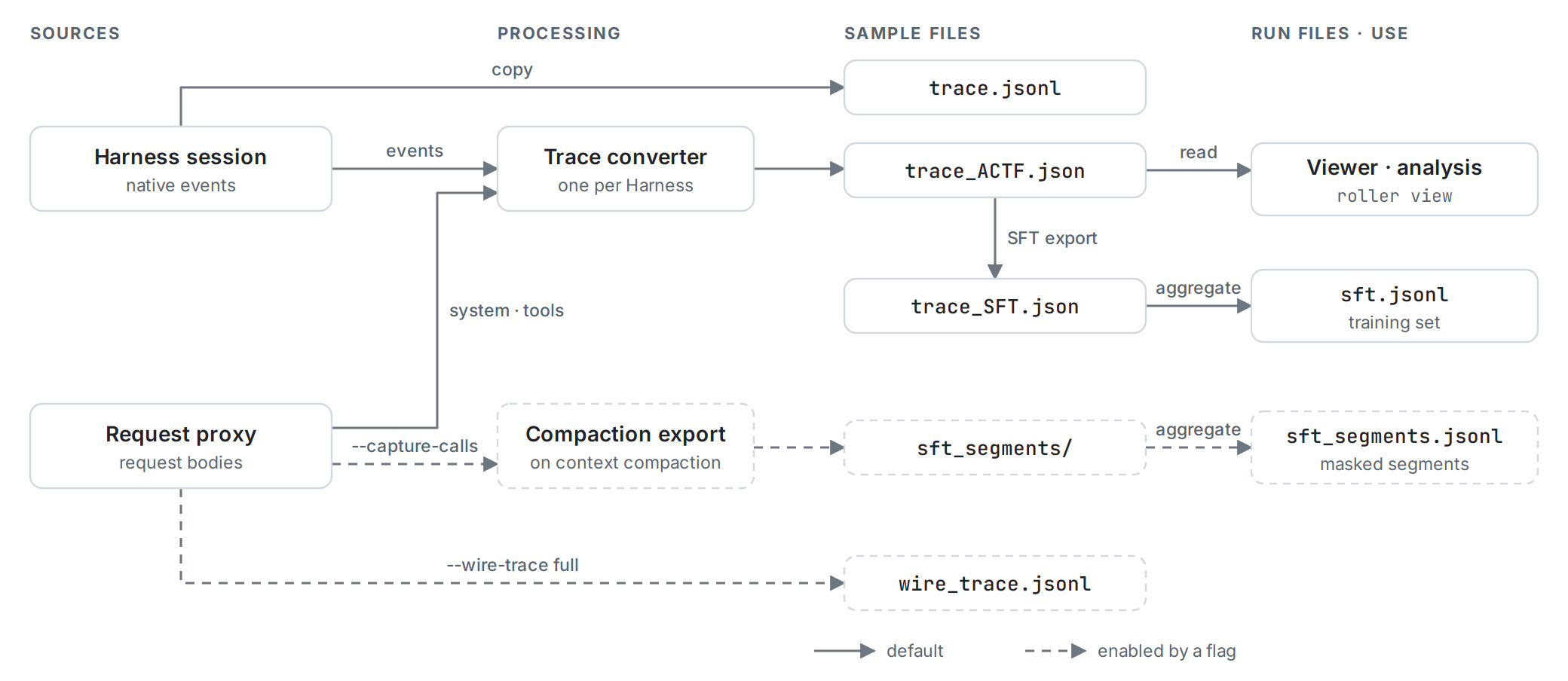
trace.jsonl records events from the current Harness session. ACTF converts
those events into an analysis format; SFT removes fields that training does not
need. SFT is not used to generate ACTF or raw.
3.1 The three files answer three different questions
| File | Capture point | Can answer | Cannot be used to claim |
|---|---|---|---|
trace.jsonl | Harness session export layer | Which user/assistant/tool events the Agent recorded, in what order, with what usage | Which full history a given request carried; verbatim upstream HTTP request/response |
cache_trace.jsonl | OpenClaw context-assembly diagnostic point | The assembled system prompt and related diagnostic stages for each LLM call | Full messages/input and final provider request parameters |
wire_trace.jsonl (full) | After the Harness provider adapter, before the real model API | The JSON body forwarded by Roller's proxy, including messages/input, tools, and sampling parameters | How the model service tokenizes, truncates, or routes the request internally |
3.2 Session history is not the model request context
The presence of a message in trace.jsonl means only that it entered the Harness
session record. It does not mean that it was sent verbatim on every later model call. OpenClaw
builds a runtime context from the session, bounded by the context window. Its
official docs distinguish the persisted transcript from the model context:
compaction replaces older history with a summary and keeps recent messages;
pruning can remove old tool results from the in-memory prompt without rewriting
the on-disk transcript. A plugin context engine and runtime hooks can also take
part in context assembly. See
OpenClaw Context and
Session Management and Compaction.
The exact compaction, pruning, and persistence behavior depends on the OpenClaw
version in the image, the model profile, and the chosen context engine. Roller
does not infer those transforms from session files; it captures full wire at the
final API request boundary. Codex likewise inserts base/developer instructions,
environment context, a tool namespace, resume history, and compaction results
between the native session and the Responses input; that final shape can only be
confirmed from full wire. Claude Code's native session is also not an Anthropic
Messages request: the CLI adds system blocks, a tools schema, project/context
instructions, cache markers, and conversation-management results. To inspect
the model request, use Claude Code --wire-trace full.
Session records and requests can differ in these ways:
- Present in the session, absent from the model request: old tool results were pruned, history was compacted into a summary, or messages were filtered by window or provider rules;
- No matching per-event record in the session, but present in the model request: the assembled system prompt, tools schema, workspace/bootstrap injection, or per-turn runtime context / hook additions;
- Still present, but represented differently: the Harness/provider adapter can
turn internal messages/blocks into the final Chat Completions
messagesor Responsesinputprotocol shape.
Use trace.jsonl to review the Agent's logical trajectory and wire_trace full
to inspect the JSON context sent in each HTTP model request. ACTF/SFT are
converted from session raw and cannot reconstruct each request
after compaction, pruning, or temporary context injection.
4. How the core trace files differ
4.1 trace.jsonl: Harness-native raw trace
OpenClaw content includes raw message events from the transcript: user,
assistant, thinking, tool call, tool result, usage, and so on. In the default
image, Roller reads events by exact session identity through the public
openclaw/plugin-sdk/session-transcript-runtime, then serializes them one by
one as JSONL. It does not delete, merge, or reorder valid events for training.
In this context, "raw" is relative to Roller's ACTF/SFT conversion. It is not a byte copy of
the underlying SQLite/JSONL file, and it is not a network-level raw request or
response. The SDK returns only transcript events that OpenClaw recognizes, so
corrupt lines or non-event records in the underlying store do not appear in the
export. Roller copies the session JSONL directly only when a legacy OpenClaw
build does not provide that SDK.
Codex content comes from the native JSONL under $CODEX_HOME/sessions in the
rollout container, including session_meta, turn_context, response_item,
event_msg, compaction events, and token usage. Codex raw is likewise a
Harness-private schema. It is not the codex exec --json terminal display
stream, and it is not an HTTP wire trace.
Claude Code content comes from this rollout's main session under
$CLAUDE_CONFIG_DIR/projects plus its subagents/*.jsonl. Roller merges by
timestamp, deduplicates by native uuid, and keeps user, assistant, thinking,
signature, tool_use, tool_result, usage, and sidechain fields. It is not the
claude --output-format=stream-json terminal stream, and it is not a
byte-for-byte concatenation of the source files.
Sample info.json.trajectory.raw_schema is marked openclaw-session-jsonl,
codex-session-jsonl, or claude-code-session-jsonl respectively.
Generation conditions:
- The Harness container has started and the finish phase can export a non-empty native session. The OpenClaw legacy path requires the specified session JSONL or the latest fallback; the Codex path requires the latest native rollout JSONL; the Claude Code path requires the latest main session in this container;
- If the Harness returns success but a non-empty raw trace cannot be obtained,
the sample becomes
error; - If the Harness itself is
errorortimeout, raw is still kept whenever a transcript can still be exported.
Uses and limits:
- Suitable for tracing upstream fields, event order, and conversion issues;
- The structure belongs to the Harness and is not a stable training schema;
- It cannot by itself verify context compaction, tool-result pruning, or the
real request after provider adaptation. All seven Harnesses should use
--wire-trace full; - Chat Completions
reasoning/reasoning_textmay be normalized toreasoning_contentbefore they enter OpenClaw, so later turns can be replayed. The thinking text is unchanged, but the field signature and the upstream HTTP response are no longer a verbatim match; --no-keep-thinkingdoes not modify raw, so raw can still contain thinking produced in the current turn. That flag affects ACTF/SFT; it is not a raw redaction switch. OpenClaw can also strip later request history at the wire layer; Codex and Claude Code only control the export and do not rewriteresume/--continuecontext.
4.2 trace_ACTF.json: unified analysis trace
The ACTF top level stores schema_version, system_prompt, the full tools,
steps, and trajectory timing. Each assistant message becomes one step. A step
contains:
user_content: user input for this turn;assistant_content.reasoning_content: visible reasoning/thinking;assistant_content.content: visible reply;assistant_content.tool_calls: tool calls;observation: tool results after those calls;metric, start/end time, and stop reason.
Generation conditions:
- The Harness has obtained
trace.jsonl, and the matching adapter can produce canonical ACTF; - OpenClaw system/tools come from cache/wire capture. When missing, system is
""and tools isnull; - Codex system comes from native base instructions, developer/system messages,
and
<environment_context>before the first turn. The task user message is matched to the corresponding turn by content. Original tools come from Responses request capture, including unused tools. ACTF retains the native definitions and per-request snapshots intools_capture; missing, changing, or unsupported definitions make SFT unavailable. - Claude Code merges streamed native events that share the same
message.id, writes plaintextthinking/reasoning/analysisintoreasoning_content, and associatestool_use_idwith a latertool_result. Ciphertextredacted_thinkingstays in raw and is not converted to plaintext. When wire is present, system/tools come from the Anthropic request; otherwise system is""and a permissive schema is derived from actualtool_use.
OpenClaw ACTF freezes only the first valid assembled system prompt from the cache trace and the first non-empty tools schema from the wire trace at the top level. Codex ACTF uses native system events and original request tool definitions. Claude Code ACTF uses the first captured Anthropic system/tools, and falls back to native derivation when there is no wire. None of them store the full messages/input of every request per step. Codex additionally retains per-request tool snapshots and rejects changing tools in SFT. Use full wire to inspect those changes; OpenClaw can also combine it with the full cache trace.
As long as raw exists, Roller attempts conversion, including samples whose
Harness already failed or timed out. A failed sample may therefore still have
ACTF. Explicitly recorded conversion unavailability is stored in
runtime.trajectory_conversion, separately from the Harness collection status.
4.3 Sample-level SFT records
Linear SFT is generated from ACTF as trace_SFT.json. For main-agent
compaction, Roller reconstructs windows from captured Calls and writes
sft_segments/0001.json, 0002.json, etc., only when root Calls correspond
one-to-one with ACTF main steps, apart from summary Calls recorded by native
compaction rows. Otherwise SFT is marked unavailable while
the raw trace and capture remain. Text-only linear records contain
these top-level fields;
image records also contain images:
{"messages": [], "tools": []}
It removes schema version, task/model, usage, metric, step ID, stop reason,
timestamps, run paths, and observation metadata. An assistant always stores
role, reasoning_content, content, and tool_calls. A tool message stores
only role, tool_call_id, and string content.
SFT expresses the logical conversation reconstructed from session events. It is not a snapshot of each provider request. It is suitable for training, but not for per-request replay or for proving that an earlier tool result was still visible in a later model call.
Compaction segments instead start with the actual captured request context.
Their extra target_start_index marks the first supervised assistant message;
subsequent assistant messages are targets, while intervening user/tool messages
remain context. Segment metadata in info.json records paths, order, boundary
source, and Call IDs. If captured input cannot be represented faithfully,
Roller records SFT as unavailable and retains raw/ACTF evidence.
With --no-keep-thinking, reasoning is cleared from segment prompts as well as
targets, matching linear SFT.
These segments require an opt-in reader that honors the target mask. The
legacy run-level sft.jsonl remains linear-only.
When valid segments exist, the run root also contains sft_segments.jsonl
with those records in request order. Its reader must honor target_start_index.
Generation conditions:
- ACTF conversion succeeded;
- There is at least one user message and one non-empty assistant message;
- Every tool call has a non-empty, globally unique ID;
- Every tool call has exactly one tool result in the same step;
- The called tool exists in the top-level tools schema;
- Function arguments can be encoded as a JSON object; Codex custom input remains a string;
- User content and tool results are strings, text blocks, or image blocks with embedded base64 bytes.
Codex preserves native Responses tool definitions, namespaces, and custom grammars.
Other harnesses normalize flat/nested functions to nested function schemas. An image in a user message or tool result is exported as an <image>
placeholder plus a top-level images data-URI list; see
SFT data format for the alignment contract. Content that
cannot be exported losslessly still fails conversion: audio or other unknown block types,
unsupported media types, malformed base64, or an image block that only
references a path. The Collector records
target: "sft", status: "unavailable", and the reason in
runtime.trajectory_conversion, retaining the collection status and raw/ACTF.
Aggregation skips that sample; Resume does not call the model again for an
export failure. Roller never silently discards content.
See SFT data format for the full field definition.
4.4 sft.jsonl: run-level training set
After the Collector finishes every request, it reads eligible linear
trace_SFT.json records in request-index order and writes the run root
atomically as a stream. It validates compaction segments and writes them to
sft_segments.jsonl separately, keeping this legacy dataset linear-only.
The run summary counts such a sample as sft_segmented, not sft_included
or sft_excluded.
- Samples with
status=okare included; --resumereused samples withstatus=skippedwere originallyok, and are included as well;errorandtimeoutare not included, even if they kept partial raw/ACTF/SFT;- An empty file is still created when there are no successful samples;
- User Simulator sub-trajectories are not included.
Each line is the same JSON object as its matching sample-level SFT record. No task ID
or other metadata is added. Sample provenance must be recovered from the
adjacent run/sample info.json and from directory location.
4.5 ATIF export: trajectory.json
roller export RUN_DIR converts the ACTF of every sample to
ATIF,
the Agent Trajectory Interchange Format that
Harbor reads. It runs on an
existing run, reads trace_ACTF.json and the sample info.json, and does not
modify the run.
<run>/atif/                          # or the directory given with --output
└── <model>/
    └── <index>_<task>/
        ├── trajectory.json
        └── images/                  # present when the trajectory contains images
Every sample that has trace_ACTF.json is exported, including failed and
timed-out samples, and the document records the sample status. Samples without
ACTF are reported as skipped. Like sft.jsonl, the export covers the Task
Agent and does not include User Simulator sub-trajectories.
The documents declare ATIF-v1.7. Their fields come from these sources:
| ATIF field | Source |
|---|---|
session_id | <run-name>/<model>/<index>_<task> |
agent.name, agent.version, agent.model_name | Harness name, Harness version, and model in the sample info.json |
agent.tool_definitions | ACTF top-level tools |
system step | ACTF top-level system_prompt |
user step | user_content of an ACTF step, when it is not empty |
agent step | assistant_content of the same ACTF step, as message, reasoning_content, and tool_calls |
observation.results | ACTF observation, with source_call_id linking each result to its call |
metrics | prompt_tokens_len, completion_tokens_len, and the cache-read count of the ACTF metric; the remaining metric fields go to metrics.extra |
final_metrics | Sums of the step metrics, and cost_usd from the sample info.json |
extra.roller | Task ID, sample index, status, error, and bench scores |
One ACTF step becomes one or two ATIF steps, so step_id values differ between
the two files. Images are written to images/, named by content hash, and
referenced by relative path. A content block that is neither text nor an image
is kept as its JSON text.
ACTF fields without an ATIF counterpart are kept in the extra object of the
same tool call, result, or step, under their ACTF names. Examples are isError
and details of a tool result and finished_at of a step. ATIF only lets a
result refer to a call of its own step; a result whose call is in another step
has no source_call_id and keeps toolCallId in extra.
Harbor can validate an exported file and load it into a Claude Code or Codex session:
python -m harbor.utils.trajectory_validator runs/demo/atif/MODEL/0000_TASK/trajectory.json
harbor run -p TASK_DIR -a claude-code -m MODEL --load-trajectory runs/demo/atif/MODEL/0000_TASK/trajectory.json
5. Diagnostic and auxiliary files
5.1 Run lock.json
lock.json is written before collection so one run cannot mix samples that were
parsed under different configurations. It freezes request order, the Task Bundle
digest, model/Harness configuration, the image ID, and options that change
trajectory meaning, such as thinking and wire/cache trace. Resume compares field
by field. A mismatch prints a limited set of differing paths and stops before
the Harness starts.
The lock does not store credentials: sensitive key values are replaced with
<redacted>; URL userinfo and fragment are removed; sensitive query values are
replaced; non-sensitive query keys such as api-version are kept for
comparison. Changing a credential or pass-through env value does not make the
lock mismatch. If those values would change actual model behavior, start a new
run. Configuration objects are compared directly; task/input/context reuse the
digests the Task Bundle already has.
5.2 Run info.json
The CLI writes initial run information before collection starts. The Collector updates it on the first result, then after every additional 25 results, and also immediately when two completion events are at least 30 seconds apart. It forces a checkpoint on interrupt and during finalization. It stores:
- Roller version and collection configuration;
- Current
state:initializing,running,finalizing,finished,interrupted, orfinalization_error; - Live
total/processed/pendingprogress; - Task/model request counts;
ok,error,timeout,skippedtotals;- Token, cache, cost, and request-count totals;
- Per-sample status, error, path, and usage.
A catchable interrupt such as Ctrl-C immediately cancels samples that are
still queued and only waits for running samples to finish normally (collecting
traces and removing containers). It then writes state=interrupted and attempts
to build a partial sft.jsonl from already completed samples. SIGKILL, power loss, or host
failure cannot perform that last write, but atomic writes and periodic
checkpoints keep info.json as the previous complete snapshot. The Viewer also
scans already finalized samples.
5.3 Sample info.json
This file is written when a sample is finalized, including failed samples. It stores task/model, Harness, final status, error, attempt history, usage, elapsed time, relative paths to raw/ACTF/SFT, output recovery information, runtime, and input provenance. Metadata excluded from training data is kept here.
OpenClaw sessions sometimes record an already delivered reply again with
api=cli; genuine CLI-backend replies use that marker too. Roller does not
remove messages based on the marker alone. It deduplicates tokens and request
counts only when usage matches within the same turn and the CLI source matches
the latest provider reply's provider/model. A message is omitted only when its
final text matches the delivered text. Matched gap fills keep new text without
repeating step tokens and update the delivered text, so repeated delivery adds
neither another message nor usage.
Independent, structured, failed, or cross-source CLI replies keep their content
and usage and suspend delivery matching until another provider reply arrives.
They do not clear the provider accounting history. Only user, session, and
compaction events clear the turn history; late delivery from an older source is
not inferred. Token parsing also accepts input_tokens/output_tokens. Explicit
native input/output fields take precedence, including malformed values, so
aliases cannot hide invalid native counters.
OpenClaw 2026.7.1 CLI aggregates can combine cumulative input/output/cache
counts with the last call's totalTokens (context usage). Aggregate matching
requires all four components to match individually, and the total must equal
either the recorded cumulative total or the last call's positive total. Roller keeps
the provider-call accounting without adding that context total again. When
the latest same-source call failed, a CLI fallback is still counted separately.
After a provider retry succeeds, aggregate matching includes valid usage and
cost reported by earlier failed calls as well.
cost_usd credits only the missing amount for the matched call or the turn's
calls so far. If a provider omits cost and two CLI mirrors each report $0.05
for that call, the total remains $0.05. Per-call costs and later turn totals
covering those calls do not add up twice. A cost-only CLI mirror without token
fields is credited to the latest call only when final text and source match.
Conflicting cost reports retain the higher known amount rather than applying
refunds; these are session-reported costs, not reconciliation with a provider's
billing records.
This processing does not modify raw. Re-parsing retained raw after upgrading can produce updated
statistics, but resume does not recompute usage cached in existing info.json.
5.4 cache_trace.jsonl
OpenClaw diagnostics.cacheTrace records the assembled system prompt of every
LLM call. It is enabled by default. Roller copies it, recursively redacts
sensitive keys, then uses it to fill the ACTF top-level system_prompt.
- Default
--wire-trace actf: used for conversion, then deleted; --wire-trace full: kept in the final sample;--no-cache-trace: not created; ACTF/SFT system content is"".
The ACTF top level uses only the first stream:context.system, falling back to
the first session:loaded.system when that stage is missing. If the system
prompt changes across calls, only the original cache trace kept in full mode can
show each difference. The ACTF top-level value does not represent every step.
Redaction is based on JSON keys. It does not scan secrets in the free text of the system prompt. This file and the downstream ACTF/SFT should still be treated as sensitive data.
5.5 wire_trace.jsonl
A local reverse proxy records wire data before the request is sent to the model service:
- OpenClaw
actfrecords only the model, non-message parameters, message count, and the first non-empty tools schema. It does not record full messages/input. That temporary file is deleted after conversion; - Codex
actfcaptures original tool definitions over HTTP when an API base is configured;tools_capture.jsonlis retained while the temporary wire file is deleted; - Claude Code
actftemporarily records the first Anthropic system/tools and non-message parameters when an API base is set explicitly, then deletes the file after conversion; fullsaves every complete request body and keeps it in the final sample;- HTTP Authorization and other headers are not written to the file, but a
complete request body may contain the system prompt, user data, tool results,
and historical reasoning.
fulldoes not automatically redact that free content.
For a parseable JSON request, the proxy first applies the semantic rewrites the
current rollout needs, then records and forwards the same body. OpenClaw
--no-keep-thinking strips historical reasoning first. Codex full wire may include
input[].type="additional_tools", the programmatic tool namespace, which Roller leaves unchanged.
Full wire shows the semantic JSON forwarded to the model API, not the Harness request before processing.
Claude Code full wire saves the Anthropic /v1/messages request system,
messages, tools, thinking/output config, and sampling parameters. Roller
does not rewrite Claude Code message history. The transport-only beta=true
query and anthropic-beta header added by Claude Code 2.1.222 are removed
before forwarding. Full wire keeps the original target in path, records the
actual target in upstream_path, and records only the removed header names in
dropped_request_headers.
Limits:
- This is a request-side JSON record, not a TCP/HTTP byte-level capture. Serialization details such as JSON whitespace and field order are not part of the audit semantics;
- It does not record request headers, upstream response bodies, or streamed chunks. Response content should still be read from session raw/ACTF, which is already the event stream after Harness parsing;
- It can only prove what Roller's proxy forwarded, not whether the model service later truncated, tokenized, rewrote, or routed the request again;
- Wire writes are best effort: a single record failure does not block the model
call. For a strong audit, check that
seqis contiguous and confirm completeness against sample usage/request count and run logs; - Multi-turn requests repeat history, so file size is close to O(N²). Use it only for audit and debugging.
5.6 How to audit context compaction or rewriting
- Run a minimal reproducible task with
--wire-trace full. For OpenClaw, also keep the default--cache-trace. Do not use defaultactfas a substitute for full: it does not save messages/input. - Compare each
body.messages(Chat Completions or Anthropic Messages) orbody.input(Responses) inwire_trace.jsonlseqorder. Also checkbody.system,body.tools, and sampling parameters. - Compare the differences against session events in
trace.jsonl. Do not expect a one-to-one line mapping: one Agent turn can contain multiple model requests, and each wire body repeats the history retained at that time. - For OpenClaw, inspect the system prompt of each
stream:contextincache_trace.jsonl. For Codex, compareinstructions, developer input, and environment context across full-wire requests. For Claude Code, comparesystem/messages/toolsand thinking/output config. - If OpenClaw used
--no-keep-thinking, treat full wire as the evidence of model-visible history. Reasoning kept in session raw is diagnostic only and does not mean it was sent on later requests. For Codex and Claude Code, that flag only controls the export.
After the audit, protect or delete cache/wire files separately. They may contain repeated user input, system prompts, tool results, reasoning, file contents, and runtime injections.
5.7 results/
Created only when the task output directory contains ordinary files or directories. Roller:
- Copies every safe ordinary file and keeps the relative path;
- Records path, size, MIME, and SHA-256 in sample
info.json; - Rejects symbolic links and special files;
- Still copies safe files even when unsafe files are present, but the sample's
final status becomes
error; - Places compatible
--collect-pathoutput inresults/legacy/.
results/ is Agent deliverable output. It is not conversation training data and
is not written into sft.jsonl.
5.8 conversation.json
Created only for User Simulator tasks. It stores the user/assistant turns both sides can see, the termination reason, instructions that were pending but not delivered, participating models, and timing. It does not copy hidden reasoning, tool calls, or tool results from either side. To train or analyze either participant, use that participant's own raw/ACTF/SFT.
6. How flag combinations change traces
6.1 Wire trace
| Harness / mode | Proxy requirement | ACTF tools | Final auxiliary files | When to use |
|---|---|---|---|---|
OpenClaw actf (default) | Enabled when a proxyable baseUrl exists; degrades when missing | Full schema when capture succeeds, otherwise null | cache/wire not kept | Regular batch collection |
Codex actf (default) | Configured API base, HTTP, host network | Original Responses definitions; no inference | tools_capture.jsonl | Regular batch collection |
Claude Code actf (default) | Starts when --api-base is set explicitly | Captures Anthropic input_schema; derives from native when there is no proxy | wire not kept | Regular batch collection |
OpenClaw full | Provider must have an absolute baseUrl | Full schema | wire_trace, plus cache_trace when cache is enabled | Request-level audit |
Codex full | API base, HTTP, host network required | Original Responses definitions | wire_trace, tools_capture.jsonl | Request-level audit |
Claude Code full | Must set --api-base --network host explicitly | Captures Anthropic input_schema | wire_trace | Request-level audit |
off | Does not start a proxy for recording | OpenClaw/Codex are null; Claude Code derives from native | none kept | Minimal diagnostics-off mode |
After OpenClaw off or a degraded actf, SFT validation fails for missing tool
schema if the trajectory contains tool calls. When there are no tool calls,
SFT tools is []. Claude Code retains its native schema fallback. Codex never
infers schemas: absent capture (including off, WebSockets, or no API base),
changing definitions, and programmatic additional_tools make SFT unavailable.
See Codex tool capture.
6.2 Thinking
| Flag | Current reply | Later request history | ACTF | SFT | raw |
|---|---|---|---|---|---|
--keep-thinking (default) | Accept the backend output as returned | Keep normal Harness history | Save visible reasoning | Save from ACTF | Keep original events |
--no-keep-thinking | The current turn can still produce reasoning | OpenClaw strips later wire history; Codex/Claude Code do not rewrite resume/continue | Reasoning emptied | Reasoning emptied | Original events still kept |
--thinking LEVEL sets the reasoning level in the Harness/model request.
Whether reasoning text can be saved depends on the service response. See
Thinking configuration
for GPT native effort, open-model profiles, and OpenClaw image limits, and
Thinking configuration
for the Claude Code mapping. When the backend reports only reasoning tokens and
does not return a reasoning summary/content, ACTF/SFT have no
reasoning_content to save. A GPT compacted summary enters that field as-is;
encrypted reasoning does not enter SFT.
The default --keep-thinking retains visible reasoning returned by the service. This includes GPT summaries, Claude visible thinking, and plaintext reasoning returned by open models.
When a reasoning effort was explicitly requested, sample info.json records
runtime.thinking_audit. This audit counts only visible reasoning retained in
ACTF. If off was requested but visible reasoning is still present, its status
is mismatch and Roller records a runtime warning without deleting or changing
the returned text. With --no-keep-thinking, the status is not_observable:
an empty exported field is not evidence that the model performed no hidden
reasoning.
Samples with a mismatch keep their execution status and per-sample SFT for
inspection, but record runtime.sft_eligibility = {"eligible": false, "reason": "thinking_effort_mismatch"} and are excluded from sft.jsonl,
including on resume. no_visible_reasoning is not proof that reasoning was
disabled. Failed or timed-out samples retain available raw/ACTF evidence but
do not export per-sample SFT.
Before pruning auxiliary traces, both agent and user-simulator archives record:
runtime.wire_effort_audit: checks each outgoing request, including retries. Explicit conflicts aremismatch; omitted controls, budgets alone, and unknown encodings areunverified; missing readable requests arenot_observable. Defaultactfmode also reads native request snapshots for Pi, DeepSeek, Hermes, and OpenCode when no wire requests were captured.sourceidentifies the evidence used. The audit survives pruning.matcheddescribes client parameters, not provider compliance.runtime.completion_audit: flags a finallength,max_tokens, ormax_output_tokensstop, or an empty text answer without tool calls, asincomplete. Unknown/missing stop reasons are not inferred.not_flaggeddoes not mean the task passed. A final observed response withincompleteor a token-limit finish reason also flags truncation, even if ACTF saysstop; an earlier truncated request followed by a completed request does not.actf_completion_auditretains the original ACTF finding when overridden.- Explicit wire mismatches and these incomplete trajectories set
sft_eligibility.eligible=false, excluding them from the agent aggregate. Omitted controls alone do not trigger exclusion. Convertible per-sample SFT remains diagnostic evidence. Failed/timed-out simulator archives also omit SFT; successful simulator artifacts retain diagnostics and never enter the agent aggregate. Resume does not backfill new audits on previously collected samples.
When strict conversion produces no ACTF, Pi/OpenClaw can record
completion_audit.source=native from completed native assistant messages,
ignoring context history and partial deltas. Unknown schemas remain unobservable;
conversion is not relaxed and failed SFT is not exported.
The proxy extracts model names and finish reasons from JSON/SSE responses into
wire response_metadata events linked by request_seq, without retaining
additional response text. Archived runtime.model_identity_audit records each
wire requested_model, response_models, and finish_reasons. A name_mismatch
produces a warning but no automatic training exclusion: aliases can be legitimate.
These are server-declared names, not proof of actual backend routing. Compressed
or unknown protocols, missing fields, and capture limits do not imply a match.
The runtime audit survives default actf-mode wire pruning.
The terminal completion message and run summary.training report SFT inclusion/
exclusion, thinking mismatches, and unverified/not-observable wire audits. Counts
refer to processed primary-agent samples, including resumed ones, not HTTP
requests or simulators. Categories can overlap; missing legacy audits do not
imply a match. Reporting shares the export exclusion policy; it adds no strict
switch and changes neither execution status nor CLI exit codes. Inclusion does
not imply that a task grader passed.
Even with --wire-trace off, --no-keep-thinking must still start a proxy to
strip request history, so OpenClaw still requires a proxyable baseUrl in
--model-config. Codex and Claude Code do not perform that history stripping.
6.3 Cache trace (OpenClaw)
| Flag | ACTF/SFT system | cache_trace.jsonl |
|---|---|---|
--cache-trace (default) | Use the first captured assembled system prompt | Kept in the final sample only in full mode |
--no-cache-trace | "" | Not created |
If training needs the first assembled system prompt the Agent captured, do not turn cache trace off. To reproduce the context of every model call, ACTF/SFT alone is not sufficient; full cache/wire must also be kept.
7. Success, failure, retry, and Resume
7.1 Success guarantees
An ordinary sample with status ok normally has:
trace.jsonl;trace_ACTF.json;trace_SFT.json;info.json.
A User Simulator sample also guarantees a root conversation.json and the
Simulator's own raw/ACTF/SFT. results/, cache trace, and wire trace are always
conditional artifacts. They are not required for success. A lossless projection
may also be impossible for some native attachment or multimodal events. In that
case the sample remains a valid evaluation result, runtime.trajectory_conversion
records whether ACTF or SFT is unavailable, and run-level sft.jsonl skips it.
7.2 Failed samples
For an error or timeout sample, finalization still attempts to recover raw,
the system prompt, tools, and safe outputs, then convert ACTF/SFT. Any retained
complete or partial trajectory can be used for diagnosis, but is excluded from
run-level sft.jsonl.
These cases turn an otherwise successful Harness result into error:
- No raw session trace found;
- A required trajectory is missing without an explicit conversion downgrade;
- Copying the task output directory failed;
- A symbolic link or special file was found in the output;
- Either User Simulator participant failed, or its trajectory conversion failed.
7.3 Retry
--retries N runs at most N extra complete rollouts. Before each attempt
starts, runtime raw/cache/wire files from the previous attempt are cleaned so
attempts are not mixed. Sample info.json.attempts keeps each status and
elapsed time. Canonical raw/ACTF/SFT correspond to the final attempt. When the
final status is not ok, the sample also keeps every attempt's process logs as
rollout/*.attempt-<N>.log (for example OpenClaw's gateway.attempt-1.log and
agent.attempt-1.log) for troubleshooting.
7.4 Resume
Resume first requires the current run lock to match the old lock.json. Changes
to task/model order, the Task Bundle, model configuration, Docker image ID,
timeout, or trajectory-semantic options stop immediately so different collection
conditions are not mixed in one batch. If the old run has no lock, the current
lock is written and every old sample is rerun once. A durable migration marker
keeps reuse forbidden until the full recapture and run-level SFT aggregation
succeed, so leftover samples are not trusted even if the process is killed
before completion.
After the lock matches, --resume reuses only old samples whose status was ok
and that satisfy all of the following:
- Sample identity matches the current request;
- raw contains a valid message, and the ACTF schema / contiguous steps are valid;
- SFT is identical to the canonical projection regenerated from ACTF;
fullmode requires the wire trace to exist, and also requires the cache trace when cache trace is enabled;- The current Task Bundle digest matches the old provenance;
- Context did not use
capture=none; - Output file paths are safe, the files exist, and their sizes are unchanged;
- A User Simulator task also has a valid
conversation.json, participant info, and Simulator raw/ACTF/SFT.
A reused result is marked skipped in this run and is still written into the
new sft.jsonl. If any required file is missing or trajectory validation fails,
the entire sample is rerun. SHA-256 values stored in the output manifest are
not recomputed on Resume, so a routine checkpoint restart does not reread large
artifacts. For a content-level audit, verify that hash separately.
8. Recommended configurations
8.1 Batch-generate text/tool SFT
roller collect \
  --tasks tasks.jsonl \
  --model provider/model \
  --model-config models.json \
  --thinking high \
  --wire-trace actf \
  --output runs
Keep the default --cache-trace and --keep-thinking. This configuration
produces complete ACTF/SFT and deletes the larger diagnostic intermediate layer.
8.2 Debug reasoning, compaction, or request history
roller collect \
  --tasks tasks.jsonl \
  --model provider/model \
  --model-config models.json \
  --thinking high \
  --wire-trace full \
  --output debug-runs
Use this configuration to confirm the messages/input that OpenClaw passes to the model API after context assembly, compaction, pruning, and provider adaptation. After debugging, prefer to keep raw/ACTF/SFT. Delete full cache/wire once request-level audit is no longer needed, to reduce duplicated data and sensitive-information exposure.
9. Checks before publishing a training set
Check at least the following:
- Run
info.json.summary.failedis 0, or failed tasks have been explicitly excluded; - The number of lines in
sft.jsonlequals the number of eligible linear records; compaction segments are checked separately; - Each line has
messagesandtools; image records addimages. Only separate compaction segments addtarget_start_index; - Every assistant has
reasoning_content,content, andtool_calls; - Tool call IDs and tool messages correspond one to one;
- The tools schema is compatible with the tool format of the chat template used at training time;
- System prompts, user content, tool results, reasoning, and Agent outputs have been reviewed for privacy;
- If
--no-keep-thinkingwas used, confirm that the raw/full diagnostic layer will not be mistaken for thinking-stripped published data; - If the dataset claims to reproduce model-visible context, confirm collection
used
--wire-trace full, wireseqis contiguous, and the request count matches expectations. Do not substitute ACTF/SFT for per-request evidence;
Hermes raw uses roller.hermes-events/v1: full request snapshots, model responses/usage, and tool messages recorded before context compression. It produces no cache_trace.jsonl. See Hermes traces.
OpenCode raw uses roller.opencode-events/v1: serialized provider requests, native message/part updates, and session exports. Updates are merged by native IDs for ACTF/SFT. It produces no cache_trace.jsonl. See OpenCode traces.
DeepSeek raw uses roller.deepseek-events/v1: native SDK notifications and serialized requests. It produces no OpenClaw cache trace. See DeepSeek Harness.
Pi raw uses roller.pi-events/v1: native events, contexts, actual requests, and turn boundaries. No OpenClaw cache trace is required. See Pi Agent.