Bbox questions
A bbox question asks where something is in an image. Valen-Decision-1.5 answers with a box, its centre point and a confidence, in the same forward pass as the predicate, choice and score questions about the same input.
Every Valen-Decision-1.5 size, 0.8B to 27B, answers bbox questions in each local runtime:
- Transformers with the native weights, shown on this page.
- The Python and JavaScript SDKs with an ONNX bundle: see bbox questions in the SDKs.
- The GGUF runtime 0.2.0 with image input.
- The vLLM and SGLang plugins.
The hosted API answers bbox questions with Valen-Decision-1.5 0.8B, 2B and 4B (valen-0.8b, valen-2b, valen-4b) through /v1/decisions and /v1/systemone, one image per request.
Request
Load the model as in Transformers local inference and download the example image:
curl -fL https://valen-team.github.io/cookbook/code/media/mug-counter.jpg -o mug-counter.jpg
Add questions of type bbox. They can sit next to other question types in one request.
result = model.predict({
    "input": [{"role": "user", "content": [
        {"type": "input_image", "image_url": "mug-counter.jpg"},
    ]}],
    "questions": [
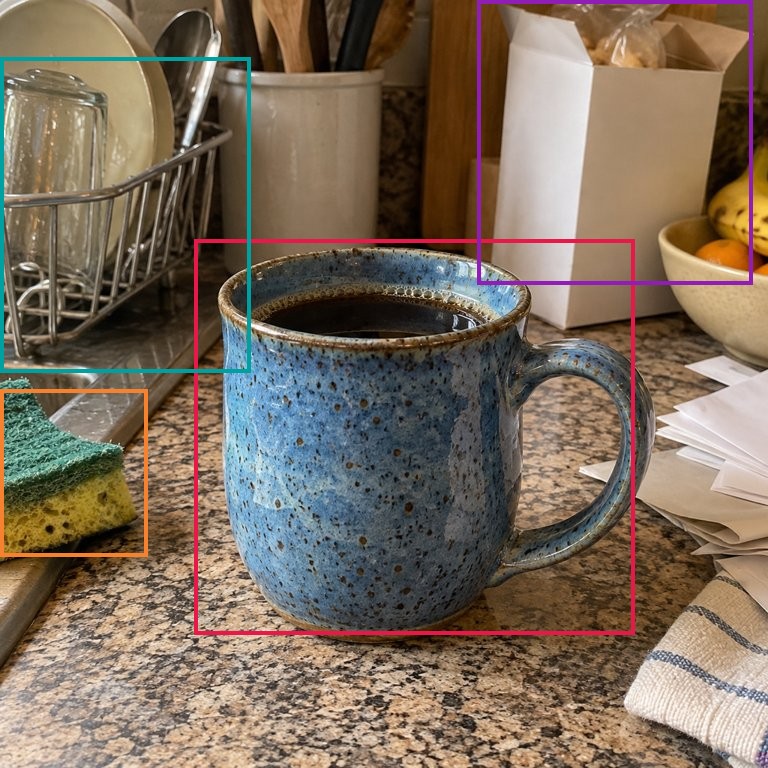
        {"name": "mug", "type": "bbox", "instructions": "The blue mug.", "image": 0},
        {"name": "sponge", "type": "bbox", "instructions": "The sponge."},
        {"name": "box", "type": "bbox", "instructions": "The white box."},
        {"name": "rack", "type": "bbox", "instructions": "The dish rack."},
        {"name": "full", "type": "predicate", "instructions": "The mug has coffee in it."},
    ],
})
for answer in result["answers"]:
    print(answer)
| Field | Type | Required | Description |
|---|---|---|---|
type | string | Yes | bbox |
instructions | string | Yes | What to locate, as nonempty text. |
image | integer | No | Zero-based index of the image to search, in the order images appear in the input. Defaults to 0. |
name | string | Yes in Decisions | Echoed in the answer. SystemOne uses the question key instead. |
A bbox question has no candidates: the image tokens are the candidates.
Answer
Output of the request above from Valen-Decision-1.5-0.8B:
{
  "model": "Valen",
  "answers": [
    {"name": "mug", "type": "bbox", "bbox": [0.2533, 0.3112, 0.8276, 0.8263], "point": [0.5404, 0.5687], "confidence": 0.9467},
    {"name": "sponge", "type": "bbox", "bbox": [0.0, 0.5077, 0.1936, 0.7243], "point": [0.0968, 0.616], "confidence": 0.9226},
    {"name": "box", "type": "bbox", "bbox": [0.6213, 0.0, 0.9816, 0.3704], "point": [0.8014, 0.1852], "confidence": 0.8785},
    {"name": "rack", "type": "bbox", "bbox": [0.0, 0.075, 0.3272, 0.4854], "point": [0.1636, 0.2802], "confidence": 0.8566},
    {"name": "full", "type": "predicate", "probability": 0.9847116274944776}
  ],
  "usage": {"input_tokens": 749, "output_tokens": 0},
  "internal_usage": {"compute_tokens": 749}
}
| Field | Type | Description |
|---|---|---|
bbox | number[4] | [x1, y1, x2, y2], the left, top, right and bottom edges. |
point | number[2] | [x, y], the centre of the box. |
confidence | number | From 0 to 1: the probability mass of the image tokens whose centres fall inside the box. |
Coordinates are normalized to [0, 1] against the original image width and height, with the origin at the top-left corner. Multiply x values by the image width and y values by the image height to get pixels: on this 768 × 768 photo the mug box is about [195, 239, 636, 635].
The output was recorded on CPU in FP32 with torch 2.14.1 and transformers 5.20.2; values on a BF16 GPU differ in the last digits. Use confidence to decide when to accept a box.
SystemOne
SystemOne uses the same question fields, keyed by question ID, and returns bbox, point and confidence under the same key.
result = model.predict({
    "state": {"messages": [{"role": "user", "content": [
        {"type": "image_url", "image_url": {"url": "mug-counter.jpg"}},
    ]}]},
    "questions": {
        "mug": {"type": "bbox", "instructions": "The blue mug.", "image": 0},
        "full": {"type": "noul", "instructions": "The mug has coffee in it."},
    },
})
mug = result["answers"]["mug"]
print(mug["bbox"], mug["point"], mug["confidence"])
Training targets
In training data, the target of a bbox question is a normalized box, {"bbox": [x1, y1, x2, y2]} with x1 < x2 and y1 < y2, or a normalized point, {"point": [x, y]}. See the data format for the rest of a training record and the architecture for how the grounding head reads the image.